
Colorado Wage Withholding Tax Guide, Overview
Colorado’s flat 4.40% income tax rate applies to wages, with requirements for employers to withhold accurately based on employee forms and filing frequencies.
Colorado’s wage withholding system ensures the state collects income tax from employees’ paychecks throughout the year. This system places the responsibility on employers to calculate, deduct, and remit these taxes to the Colorado Department of Revenue. The process hinges on information provided by employees via Form W-4 (federal) or Form DR 0004 (state), detailing their filing status and any claimed exemptions.
Accurate withholding is crucial for both employees and the state. Employees avoid potential underpayment penalties at tax time, while the state maintains a consistent revenue stream for public services. Employers must register for a Colorado wage withholding account and adhere to specific filing frequencies – quarterly, monthly, or weekly – determined by their tax liability. Understanding these requirements is paramount for compliance.
Historical Context of Colorado Taxation

Colorado’s tax history reflects its evolving landscape and population. From its Native American roots and subsequent French and Spanish influences, to its frontier American development, the state’s fiscal policies have adapted over time. Becoming the thirty-eighth state in 1876, Colorado initially relied on property and other taxes.
The introduction of a state income tax came later, evolving to its current flat rate structure. The current 4.40% rate, while seemingly straightforward, is a result of legislative adjustments responding to economic conditions and revenue needs. Understanding this historical progression provides context for the present wage withholding system, designed for efficient and consistent tax collection across the state’s diverse economy and geography.

Employer Responsibilities
Employers in Colorado must obtain a wage withholding account, utilize correct forms like DR 1098 and W-4, and adhere to specific filing schedules.
Obtaining a Colorado Wage Withholding Account
Every employer required to withhold Colorado income tax must apply for and maintain an active Colorado wage withholding account. This is a foundational step for compliant tax operations within the state. Employers can register online through the Colorado Department of Revenue website.
The application process involves providing essential business information, including the Federal Employer Identification Number (EIN), business address, and the nature of the business.
Once approved, the Department of Revenue will assign a withholding account number, which is crucial for all subsequent filings and tax-related correspondence. Maintaining an active account ensures the employer can legally and accurately remit withheld income taxes to the state, avoiding potential penalties and legal issues. Timely registration is paramount for new businesses.
Required Forms for Employers
Colorado employers must utilize specific forms to accurately calculate and remit wage withholding taxes. The DR 1098, Colorado Withholding Worksheet, is a key tool, prescribing the method for calculating the required withholding amount based on employee information.

Crucially, employers must also manage IRS Form W-4, Employee’s Withholding Certificate, alongside Colorado Form DR 0004, the state’s equivalent. New employees must submit the current version of either form.
These forms provide the necessary data – exemptions, filing status, and other relevant details – to determine the correct withholding amount. Accurate completion and retention of these forms are vital for compliance during audits and to avoid potential penalties.
DR 1098 ― Colorado Withholding Worksheet
DR 1098 serves as the primary tool for Colorado employers to precisely calculate required wage withholding amounts. This worksheet details the step-by-step method, ensuring compliance with state tax regulations. The calculation is fundamentally driven by information provided on employee withholding certificates – either the federal IRS Form W-4 or the state-specific Colorado Form DR 0004.
Employers utilize the worksheet in conjunction with employee-provided data, including claimed exemptions and filing status. Proper application of the DR 1098 minimizes errors and ensures accurate tax remittance. It’s a critical component of fulfilling employer responsibilities regarding Colorado income tax withholding.
IRS Form W-4 and Colorado Form DR 0004
Both the federal IRS Form W-4 and Colorado Form DR 0004 are crucial for determining accurate employee withholding. New employees are required to submit the current version of Form W-4. Form DR 0004 allows employees to specify Colorado-specific withholding preferences, potentially adjusting federal withholding to align with state tax obligations.
Employers rely on the information provided on these forms – including filing status, exemptions, and any additional withholding requests – to calculate the correct amount of state income tax to withhold from each paycheck. Utilizing both forms ensures compliance with both federal and Colorado tax laws, preventing potential under or over-withholding issues.
Filing Frequencies and Due Dates
Colorado offers varying filing frequencies – quarterly, monthly, or weekly – determined by the employer’s total tax liability. Accurate and timely filings are essential for compliance and avoiding penalties. Employers must register for a Colorado wage withholding account to determine their specific filing schedule.
Consistent adherence to due dates is critical. Failure to file on time or remit taxes promptly can result in penalties and interest charges. Employers should consult the Colorado Department of Revenue website for the most up-to-date filing calendar and specific deadlines corresponding to their assigned filing frequency.
Quarterly Filing
Employers assigned quarterly filing status must submit Form DR 0207, the Colorado Quarterly Employer’s Withholding Tax Return, four times annually. These returns cover withholding taxes for specific periods: January-March, April-June, July-September, and October-December.
Due dates for quarterly filings are typically April 30th, July 31st, October 31st, and January 31st of the following year. However, these dates can shift if they fall on a weekend or holiday, so employers should verify the exact deadlines on the Colorado Department of Revenue website. Electronic filing is encouraged for efficient processing and confirmation of receipt.
Monthly Filing
Employers designated for monthly filing are required to submit Form DR 0207, the Colorado Quarterly Employer’s Withholding Tax Return, on a monthly basis. This filing frequency is generally assigned to employers with a substantial payroll volume or a history of significant tax liabilities.
Monthly returns are due by the 15th day of the following month. For example, withholding taxes for January are due on February 15th. As with quarterly filings, if the due date falls on a weekend or holiday, it will be adjusted accordingly. Employers should always confirm the precise due dates via the Colorado Department of Revenue website. Electronic submission is strongly recommended.
Weekly Filing
Employers required to file weekly are generally those with the highest payroll volumes, often exceeding significant thresholds set by the Colorado Department of Revenue. These employers must submit Form DR 0207, the Colorado Quarterly Employer’s Withholding Tax Return, on a weekly schedule.
Weekly returns are due every Monday following the end of the weekly withholding period. It’s crucial to note that the specific day of the week for filing can vary depending on the employer’s assigned schedule. Employers should verify their assigned schedule with the Department of Revenue. Electronic filing is mandatory for weekly filers, ensuring timely and accurate tax remittance.

Colorado Income Tax Rates
Colorado maintains a flat income tax rate of 4.40% for 2025, applying consistently to both regular wages and supplemental income like bonuses.
Standard Income Tax Rate (2025)
Colorado’s standard income tax rate for the year 2025 is firmly set at 4.40%. This flat rate applies to the vast majority of taxable income earned by Colorado residents throughout the year. It’s a straightforward system, simplifying calculations for both employers and employees when determining withholding amounts.
Unlike states with tiered tax brackets, Colorado doesn’t adjust the rate based on income levels. Every dollar earned above the standard deduction is taxed at this consistent 4.40%. This predictability aids in financial planning and budgeting for individuals. Employers are responsible for accurately withholding this percentage from employee wages, ensuring compliance with state tax regulations. The simplicity of this flat rate contributes to a more manageable tax landscape within the state.
Supplemental Wage/Bonus Rate
Colorado applies the same 4.40% tax rate to supplemental wages and bonus income as it does to regular wages. This consistency simplifies withholding calculations for employers when distributing bonuses, commissions, or other non-wage compensation to employees. While some states utilize different rates for these types of payments, Colorado maintains a uniform approach.
This means that bonuses, regardless of amount, are subject to the standard 4.40% income tax withholding. Employers must accurately calculate and withhold this amount to ensure compliance with state tax laws. It’s crucial to treat supplemental income the same as regular wages for withholding purposes, avoiding potential penalties or discrepancies during tax filing. This straightforward rule streamlines the process for both employers and employees.
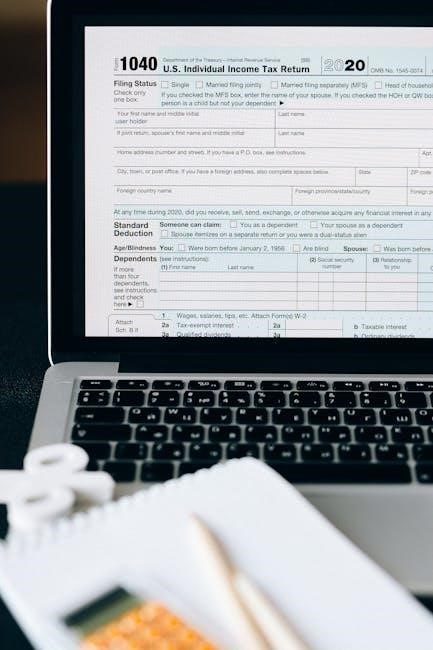
Employee Withholding Certificates
Employees utilize IRS Form W-4 and Colorado Form DR 0004 to declare withholding status, exemptions, and deductions to employers for accurate tax calculations.
Understanding Form W-4
Form W-4, officially titled “Employee’s Withholding Certificate,” is a crucial document for federal income tax withholding. New employees must submit the current version of this form to their employer. It dictates how much federal income tax is withheld from their paycheck.
The form guides employers in calculating the correct amount to withhold based on the employee’s filing status (single, married filing jointly, etc.), claimed dependents, and any additional income or deductions. Recent updates to Form W-4, implemented in 2020, eliminated allowances and introduced a more streamlined approach focusing on annual income and deductions.
Accurate completion of Form W-4 is vital; errors can lead to under- or over-withholding, potentially resulting in tax liabilities or a larger refund than expected during tax filing season. Employees should review and update their W-4 whenever their personal or financial circumstances change.
Understanding Form DR 0004
Colorado Form DR 0004, “Employee’s Withholding Certificate,” mirrors the federal Form W-4 but is specific to Colorado state income tax withholding. Employees utilize this form to inform their employers about their filing status, exemptions, and any additional withholding requests for Colorado taxes.
Like the W-4, accurate completion of DR 0004 is essential for ensuring the correct amount of Colorado income tax is withheld from each paycheck. This prevents potential underpayment penalties or an unexpectedly large tax bill when filing the annual Colorado income tax return.
Employees should submit a new DR 0004 whenever their circumstances change – such as a marriage, divorce, birth of a child, or significant changes in income or deductions – to maintain accurate withholding throughout the year.
Employee Responsibilities Regarding Withholding
Employees bear the primary responsibility for ensuring accurate Colorado income tax withholding. This begins with completing both Form W-4 (federal) and Form DR 0004 (Colorado) truthfully and promptly upon starting a new job.
It’s crucial to update these forms whenever personal circumstances change – marriage, divorce, dependents, or significant income shifts. Failing to do so can lead to incorrect withholding, resulting in underpayment penalties or a larger tax liability at filing.
Employees should also review their pay stubs regularly to verify the accuracy of the withholding amounts. If discrepancies are found, they should immediately notify their employer to rectify the issue and ensure compliance with Colorado tax laws.

Calculating Colorado Wage Withholding
Withholding is determined using the DR 1098 worksheet, factoring in employee exemptions claimed on Form W-4 or Form DR 0004.
Using the DR 1098 Worksheet
The DR 1098 worksheet, provided by the Colorado Department of Revenue, is the primary tool for employers to accurately calculate employee wage withholding obligations. This worksheet meticulously guides employers through a step-by-step process, ensuring compliance with Colorado’s tax laws.
It begins with gathering information from the employee’s Form W-4 or Form DR 0004, specifically focusing on claimed exemptions and any additional withholding requests. The worksheet then utilizes these details, alongside the employee’s gross wages, to determine the appropriate withholding amount.
Employers input wage brackets and apply the corresponding tax rates, ultimately arriving at the total Colorado income tax to be withheld. Utilizing this worksheet minimizes errors and ensures accurate tax remittance, avoiding potential penalties and interest charges from the state.
Withholding Based on Employee Exemptions
Colorado withholding calculations are directly influenced by the exemptions claimed by employees on Form W-4 or Form DR 0004. Exemptions reduce taxable income, consequently lowering the amount of tax withheld from each paycheck.
Employees claiming zero exemptions generally have a higher withholding rate, as they are presumed to have significant tax liability throughout the year. Conversely, those claiming multiple exemptions experience reduced withholding, reflecting a lower anticipated tax obligation.
Employers must accurately reflect these claimed exemptions when utilizing the DR 1098 worksheet. Incorrectly applying exemption information can lead to under or over-withholding, potentially resulting in penalties or necessitating adjustments during tax filing season. Careful attention to detail is crucial for accurate withholding.

Specific Withholding Scenarios
Colorado requires specific withholding methods for salaries, bonuses, and supplemental income, as well as adjusted rules for non-resident employee compensation.
Withholding on Salaries and Wages
Withholding from regular salaries and wages in Colorado is primarily determined by the employee’s Form W-4 or DR 0004, dictating exemptions and allowances. Employers utilize the DR 1098 worksheet to calculate the precise amount to withhold, ensuring compliance with state regulations.
This calculation considers the employee’s taxable income, filing status, and any claimed exemptions. The 4.40% flat tax rate is applied after these adjustments. Accurate record-keeping of employee withholding certificates is crucial for proper tax administration. Employers must also adhere to established filing frequencies – quarterly, monthly, or weekly – based on their total tax liability. Consistent and accurate withholding prevents potential penalties and interest charges from the Colorado Department of Revenue.
Withholding on Bonuses and Supplemental Income
Colorado applies a flat 4.40% tax rate to bonuses and other supplemental income, mirroring the standard wage rate. However, withholding methods differ slightly from regular salaries; Employers generally withhold based on an aggregate method, combining the supplemental payment with the employee’s regular wages for the pay period.
Alternatively, a percentage method can be used, applying the flat tax rate to the bonus amount. Utilizing the DR 1098 worksheet remains essential for accurate calculations. Proper withholding on supplemental income prevents underpayment issues and potential penalties. Employers should clearly document the method used for withholding and maintain accurate records of all supplemental payments and associated taxes. Consistent application of the correct method is vital for compliance.
Withholding for Non-Residents
Colorado requires income tax withholding from the wages of non-resident employees working within the state. The standard 4.40% flat tax rate applies to their earnings, just as it does for residents. However, determining withholding obligations can be more complex for non-residents, especially those with income sourced from multiple states.
Employers must accurately determine the portion of the employee’s income earned in Colorado. Utilizing Form DR 0004, the Colorado withholding certificate, is crucial. Non-residents may be eligible for exemptions or adjustments based on reciprocal agreements with other states. Careful attention to residency status and income allocation is essential to ensure correct withholding and avoid potential tax liabilities for both the employee and employer.

Penalties and Interest
Late filing and underpayment of Colorado income tax incur penalties and interest charges, impacting employers and potentially employees, requiring timely compliance.
Penalties for Late Filing
Colorado imposes penalties for failing to file wage withholding returns and payments on time. The penalty is a percentage of the unpaid tax, increasing with the length of the delay. A failure-to-file penalty applies if a return isn’t submitted by the due date, even if tax isn’t owed.
The penalty structure includes a base percentage, escalating monthly. Late payment penalties also accrue on any unpaid tax amount, calculated from the original due date until paid. Consistent late filing can lead to more severe consequences, including potential audits and legal action. Employers should prioritize timely submissions to avoid these financial repercussions and maintain compliance with Colorado tax regulations.
It’s crucial to note that penalties are subject to change, so referencing the latest Colorado Department of Revenue guidelines is essential.
Interest on Underpayment of Tax
Colorado assesses interest charges on any underpayment of wage withholding taxes. This interest is applied to the unpaid tax amount from the original due date of the return until the date of full payment. The interest rate is adjusted quarterly, based on the federal short-term rate, ensuring it reflects current market conditions.
Even if a penalty is waived due to reasonable cause, interest will generally still apply to the underpaid tax. Employers are responsible for calculating and remitting interest alongside any outstanding tax liability. Prompt payment of the full tax due is the best way to avoid accruing interest charges and potential financial burdens.
Refer to the Colorado Department of Revenue for the current interest rate and detailed information regarding its calculation.

Resources and Further Information
Colorado’s Department of Revenue and Department of Labor & Employment websites offer comprehensive guidance, forms, and updates on wage withholding taxes.
Colorado Department of Revenue ― Taxation Website
The Colorado Department of Revenue’s Taxation website serves as the primary resource for all matters related to Colorado state taxes, including wage withholding. Employers can find detailed information regarding obtaining a withholding account, filing requirements, and due dates for quarterly, monthly, or weekly filings.
Crucially, the website provides access to essential forms like the DR 1098 – Colorado Withholding Worksheet, used to calculate the correct amount of tax to withhold from employee wages. Taxpayers can also locate information on IRS Form W-4 and its Colorado equivalent, Form DR 0004, which employees use to communicate their withholding preferences.
Furthermore, the site offers current tax rates, including the standard 4.40% income tax rate and the supplemental wage/bonus rate, alongside publications, FAQs, and contact information for assistance. Regularly checking this website ensures compliance with the latest Colorado tax laws and regulations.
Colorado Department of Labor & Employment
The Colorado Department of Labor & Employment (CDLE), while not directly administering wage withholding taxes, plays a vital role in employer responsibilities within the state. CDLE focuses on worker’s compensation, which is a separate requirement for employers, but intersects with overall payroll management.
Employers are required to maintain an active Colorado wage withholding account, and CDLE’s website provides resources related to employer obligations, including information on registering a business and understanding labor laws. While wage withholding is handled by the Department of Revenue, CDLE offers guidance on related employment regulations.
Specifically, CDLE provides information on employer tax rates, including worker’s compensation rates, and ensures compliance with employment standards. Accessing CDLE’s resources alongside the Department of Revenue’s ensures a comprehensive understanding of all employer obligations in Colorado.
Be First to Comment